Monday, August 7, 2017

Spirit of Learning (Recent thoughts on Education)

(I wrote this for my students but it certainly applies to all of life.)

Go! Do! Be More! Faster! Harder! Aaaaaaah!

It seems the world is pushing us to hurry up and . . . what?  . . . be successful?
What does that even mean?

I have been reading a very interesting book called The Subtle Art of Not Giving a F---K, by Mark Manson. Despite its punchy title, it is a powerful little book that puts into perspective what it is we are here to do in this lifetime and what really matters. I highly recommend it.

The reason I bring it up is that I have found recently that many students have forgotten what it really means to get an education. News Flash: Education is not merely preparing to have a job.  If you are well educated it is more likely you will get a job, but education does not have the explicit goal of getting you a job. Training will get you a job. Education will give you quality of life. 

The Spirit of Learning is the spirit of real education. And, that is what I am most interested in as a teacher, as a human!.  What is the bigger picture here? So, when you submit an assignment (as crazy making as it can seem) it is not about the length, it is not about the number of sentences, words, characters. Everything you turn in for credit is an opportunity to show me that you are putting in the time to investigate the content of the course and most importantly how it changes you, your views, your appreciation. your world! This is the stuff that will enrich your life and make it meaningful.
Counting points to get that A (or B or C) will only torment you. That is not the spirit of learning.
I promise that if you do your best to communicate the spirit of your learning in each and every assignment the grade will follow. Because you will actually be learning.

Things that require you to work hard are thing worth having. Freebies are transient and disposable.  They may make you happy in the short term, but they will not make you happy in the long term.

Give yourself a chance to enjoy your education.
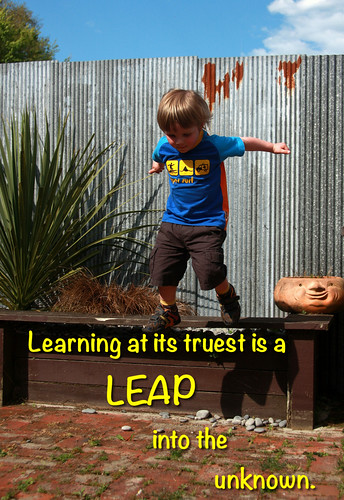
Learning
3 Tips for the Spirit of Learning
Ask yourself:
1. "What is the goal of this assignment?" "Why would my teacher assign it to me?" Answer those question within your submission.

2. "How am I representing myself in my work?" "Do I express that I learned something from the assigned reading?" "Do I honor the process with full sentences and grammar?" Ensure your submission reflects your mature thinking and values.

3. "Is there a way I could actually make this FUN?" That doesn't mean you have to spend MORE time on the assignment, it is about your ability to enjoy the challenge and/or process while you are working. (In fact it might actually take you less time working this way. . . just sayin')

Saturday, July 16, 2016

Making the Dance I’ve Not Made Before

As an artist it is easy to explore and re-explore a structure, topic, theme, motif, etc.  And, there is tremendous value to this deepening of the creative experience surrounding a single concept.  When we dive again and again into the waters of a single idea, we see new light, new shade, new nooks and crannies of potential. It is a beautiful practice.  The challenge in the dance world is that our field has been consistently fascinated with that which is new.  Dance makers are often seeking something new and different from their work.  There is a common striving for continual reinvention of aesthetic.  And, yet, it is hard to escape ourselves.

And, we often end up making the same dance over and over. Maybe different costumes or music or lighting, but essentially the same thing over and over. 

Tough.

So, as I reflect on my newest creative endeavor, I am wondering do I try to create something new? Do I deepen something I have explored before?  And, more importantly, how do I know if I am doing what I set out to do?  Either approach is fine, but what I don’t want is to create the same dance again thinking that I am being innovative when I’m not. 

So what do I do? Where do I start?  I know some of my favorite choreographic devices. I know them well.  In fact choreographic structure, use of theme and form are strengths of mine as a choreographer. I like looking at the arc of a piece, the sense of wholeness, and the overall effect of the structure for a narrative or aesthetic purpose.  I notice that I like introducing dancers in the same way. I like grouping them on the stage in certain ways. I like balancing unison with counterpoint.  And, I love front facing and diagonal front facing (mostly for the narrative or human component of the work—after all, comedy doesn’t work quite the same when turned away from the audience).   

Now, what do I do with this information?  I want to make a new dance.  I don’t want to see myself pull out the old tricks again. At least, not this time.  So, I am dedicating myself to avoid these patterns at all costs.  I force myself to do something else. Anything else!

The dance I want to make next has the working title of Dances to Heal the Soul. Each section addressing a different style and aesthetic to serve a goal that touches the spirit, heals the soul, soothes the heart. 

Maybe, I will resort to my old ways. The comfortable habits of creation.  But, maybe I will find something new in the process.  Maybe the dance will root itself in a new value, in a new structure, or in a new aesthetic.  I can only hope. 

In the meantime, as I allow all of this to incubate in my brain, before I get into the studio, I will dream the new dream.